TL;DR: The sorting has already started. Half my friends are about to be looking for jobs. The other half won’t be. The gap between them is what you do tonight.
Last year I wrote about a couple of Art Directors I worked with in 1996 who wouldn’t put down their drafting tables. Adobe Illustrator was sitting right there on every other desk in the office. Their junior designers were running circles around them. They were so good at their jobs that they couldn’t see the floor moving under them until they were on it.
I called it then. I underestimated how fast the floor would move this time.
Eight months later, I’m watching the same pattern play out…only the stakes are different. The first time around, the Art Directors had three years to figure it out before the industry left them behind. This time, the people I’m watching have about eighteen months.
What I’m Seeing
I’m seeing people who used to be at the top of their field scrambling right now to catch up because they didn’t pay attention.
I’m seeing the ones who embraced this last year getting 5x done in a day while their peers give them side-eye for “using AI to do something they could have done manually.”
I’m seeing a lot of smart people who still think this is a productivity hack. It’s not. It’s a phase change.
There are two groups of knowledge workers right now. One group is using AI to do their job faster…Copilot writing Excel formulas, ChatGPT cleaning up email drafts, Notion AI summarizing meeting notes. The other group is using AI to do work that wasn’t on their job description. Building things. Shipping things. Solving problems their team didn’t have the bandwidth to touch.
Only one of those groups is going to be employable in eighteen months.
The Receipt
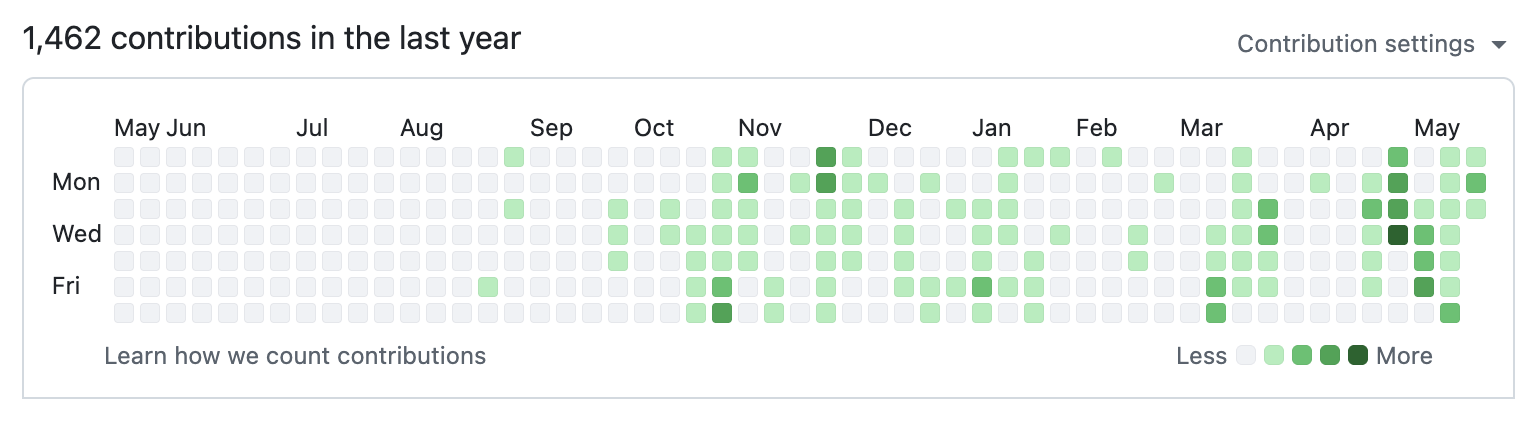
Eight months ago I wasn’t writing code. I’m 51 years old. Here’s what happened when I stopped making excuses and started building.
The empty half of that graph is when I was watching this from the sidelines. The green half is when I decided to stop watching.
I’m not posting it to flex. I’m posting it because if a 51-year-old who hadn’t written a line of code in 20+ years can do that in eight months, the “I’m not technical” excuse died sometime around last Thanksgiving.
The Compression Is Real
A few years back I built an app with a team of fifteen people. It cost over a million dollars. It took the better part of a year.
I could build it myself tomorrow. In a matter of weeks. And you wouldn’t be able to tell the difference.
That’s not hyperbole. That’s not a sales pitch. That’s just the math right now. Two weeks ago I shipped eleven of twelve roadmap items for an encrypted Agent-to-Agent messaging protocol in a single day. Yesterday my Agent fleet shipped five PRs against the runtime I’m building. Thousands of lines of clean code every day. (With the unit tests to back it up.) The compression isn’t coming. It’s here, and it’s accelerating.
This is going to do to the workforce what the web did to newspapers. Faster. Less merciful. And the people running Fortune 500 companies all know it.
The Game of Chicken at the Top
Every Fortune 500 CEO knows what’s coming. They’re not afraid that AI will make them less profitable…the opposite is true. AI is the most attractive cost-reduction story Wall Street has seen in a generation. They’re afraid of being the first one to say it out loud.
It’s a game of chicken right now. Every one of them knows they only need about 50% of their workforce to produce the same output. None of them wants to be the first CEO to lay off half their company. So they’re waiting. Watching each other. Hoping someone else flinches first, because once one of them does, the rest get to say “me too” instead of “I decided this.”
Wall Street is going to force the issue. Pick a quarter, any quarter in the next eighteen months. Once one company quantifies the savings on an earnings call, the rest will follow within two quarters. That’s not a prediction. That’s how this kind of cascade has played out every other time. Newspapers, retail, taxis, hotels. Pick your industry.
The difference this time is that the cascade isn’t industry-specific. It’s job-specific. Every knowledge worker in every industry is on the same clock.
Why I’m Building 2200
I didn’t sit down a year ago and decide to build infrastructure for AI Agents. I ran into the problems in order, and nobody else had solved them yet.
It started with Shopify. I needed a better way to onboard products onto my store. So I built one with the help of an Agent. That worked so well it became the foundation for an AI-native marketplace. The marketplace needed multiple Agents working together, so I built OpenPub…a substrate where they could communicate, leave signed memory fragments, and coordinate. The social network part of it was a byproduct, not the original intent.
OpenPub solved the messaging problem, but the Agents started needing to pass credentials between each other, and you don’t pass credentials over a coffee-shop bulletin board. So I built OpenSCUT…Signal-grade encryption for Agent-to-Agent messaging. Now they could coordinate securely.
But by then I had so many Agents doing so many distinct things that I needed a real runtime to manage them. A place to spin up named Agents with specific roles, give them context, let them work as a team, and orchestrate themselves while they were doing the work. That’s 2200.
I have an Agent named Hobby who’s my primary builder. An Agent named Simon who manages my home infrastructure and the cloud droplets. An Agent named Garfield who’s been shipping the SCUT protocol. An Agent named Guppi who holds the architectural through-line across all of it. I can go on and on. All have a role…and none of them are generalists. I build up Agents that are the best at their swim-lane, I train them well, and then let them do their jobs. Exactly how I build companies. Hire the best person for that job and then trust their judgement.
This isn’t a chatbot. This is a team. And I’m the only human on it.
Why Your Skills Still Matter
Here’s the part that’s going to surprise some of you.
The thing you’re really good at right now is the thing AI can’t replace. Agents aren’t proactive. They’re only as good as the input. A human who deeply understands a problem will always beat an Agent with no direction. Always.
The people who are about to get replaced aren’t the ones who do the work well. They’re the ones who can’t describe the work well enough to direct it. People who write code are about to be replaced by people who can document what they’re doing better than they can code it. The “what to do” is more important than the “how it gets done.”
I’ve been telling dev teams for decades that I’d rather they spend an hour writing documentation than an hour writing code. This is where that pays off. The Agent will write the code. The human writes the spec. And the human who can write a clear, complete, unambiguous spec is more valuable than they’ve ever been.
If you’ve spent twenty years getting really good at your job, you haven’t been doing it wrong. You’ve been building the exact judgment an Agent can’t manufacture. The trick is to stop using that judgment to do the mechanical parts yourself, and start using it to direct an Agent that does the mechanical parts for you.
What To Do Starting Tonight
If you’re reading this and you’re worried, that’s the right response. Now do something with it.
Stop using AI as a faster pen. If your AI use case is “it writes my emails faster,” you’re losing. Use it to build something. Use it to solve a problem your company hasn’t solved. Use it to ship something that wasn’t on your job description.
Pick a project at home and finish it. Pick something that you’ve always wanted to do but assumed would take too long or cost too much. Use an Agent to do it. Ship it. Use it yourself. Then walk into work on Monday and say “I built this last weekend.”
Learn the vocabulary. Agent. MCP server. Tool call. Skill. Capability. Walkthrough. Markdown. If those words don’t mean anything to you today, you have homework tonight. You don’t need to be an engineer. You need to know what these things are well enough to have a conversation about them without nodding politely.
Document better than you code. Write specs. Write briefs. Write tickets. Write decision docs. The skill that’s about to be the most valuable knowledge-work skill in the world is the ability to describe a system completely enough that someone else…human or otherwise…can build it without asking you a follow-up question.
Put your notions of what can’t be done aside. You don’t think it can because you haven’t dared to dream. There’s a better way to do your job right now. It would take fifteen layers of red tape to get approved at your company. So do it yourself at home. Show up Monday with receipts.
When the conversation comes at your company…and it’s coming…be the one who’s been doing this for six months. Not the one asking what an Agent is.
The Drafting Table Is Still Right There
Last year, I wrote that the drafting table was comfortable, but it was time to let it go. I was talking about software engineers refusing to adopt AI coding tools.
Today I’m talking to everyone. Every accountant, every analyst, every product manager, every marketer, every operations person, every middle manager who’s been doing the same job for fifteen years and is really good at it.
The drafting table is still right there. So is Adobe Illustrator. The Senior Art Directors who picked up the new tool are still working. The ones who didn’t are doing something else now.
The tools are sitting on the desk. They’re not perfect. They’re getting better every week. The people who pick them up tonight are going to be unrecognizable a year from now.
The pink slips are coming. Not because AI replaces people. Because the people who actually use AI replace ten of them.
The question isn’t whether the sorting happens. The question is which side of it you’re on.
I’m 51. I started eight months ago. You can start tonight.
If this hit, the original Drafting Table Problem from last year is right here. Same pattern. Smaller stakes. I called it then. I’m calling it again now.