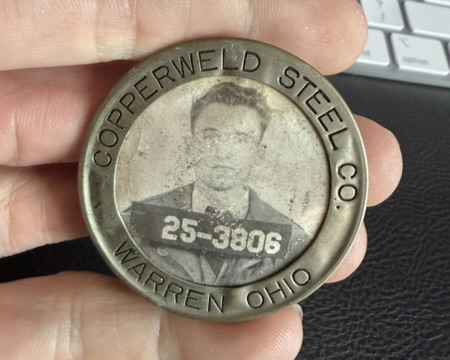
There’s a metal disc on my desk. It’s a little bigger than a silver dollar, a little heavier. Nickel or some other base metal, pitted and scratched from being carried around for decades before it ever ended up on my desk. Stamped in raised letters around the rim: COPPERWELD STEEL CO. on the top arc, WARREN OHIO on the bottom. In the middle, behind a sealed window of hard plastic, a young man’s face. Hair slicked back, jacket and what looks like a tie, the formal first-day-of-work portrait. Across his chest, held in front of him like a mugshot board, a board with a number. 25-3806.
It’s an employee badge. The kind a steelworker would have clipped to his chest or kept in his wallet to walk through the gate every morning. It belonged to Jim Wojtowicz. Jim was my grandmother’s oldest brother. My great-uncle.
This is the closest I have to a face for him.
I knew Jim, but only in the way you know someone when you’re a kid at family gatherings. He was one of the uncles, and there were many. My grandmother had nine siblings. Five brothers and four sisters. By the time I was old enough to register names and faces, the family parties were already enormous, twenty or thirty people in a kitchen, and Jim was somewhere in the room. He died in 1991. I was sixteen. I have flashes of him, not stories. The stories are the part I’m chasing now, and the more I chase them the bigger they get.
Here’s what the records say.
Jim was born November 18, 1913, in Scarbro, West Virginia. Scarbro was a coal patch town in the New River coal field of Fayette County. It was owned by the White Oak Coal Company. It existed because the company built it to house the men who worked the mine. Jim’s father, George, was Polish, born in 1887, and had immigrated to America to work the New River seams. His mother, Mary, was also Polish, born in 1893. They married in Scarbro on January 29, 1913. Jim was born ten months later in a company-built house, in a hollow named after an English village, surrounded by other Polish and Hungarian and Italian families whose men all walked to the same mine every morning.
By 1908, Polish immigrants were the third-largest ethnic group in West Virginia coal mining. Fayette County and Raleigh County were the heaviest concentrations. Scarbro was one of dozens of small coal patches strung along the New River where Polish-speaking families like the Wojtowiczes lived inside an industry that paid in scrip at a company store and gave you a house only as long as you could swing a pick. The year Jim was born, the Paint Creek-Cabin Creek strike was happening thirty miles to the west. Mother Jones was there. The state militia was there. Men were getting killed over the right to organize. George kept his head down and kept working, because he had a wife and a baby and another one on the way.
The family stayed in Scarbro for at least the next fifteen years. Pauline came in 1915. Helen in 1917. Olga in 1919. Leon in 1921. Elizabeth in 1924. Joseph in 1926. Walter in 1927. By the time the youngest West Virginia child was born, the coal industry was already turning. Prices were soft. The Florida boom had collapsed. The Depression was coming. Polish families with growing children started looking north toward the steel valleys of Ohio and Pennsylvania, where the wages were better and the company-store grip was looser.
The Wojtowicz family moved to Trumbull County, Ohio sometime in the late 1920s, in the narrow window between Walter’s birth in West Virginia and Louise’s birth in Ohio in 1928. My grandmother, Louise, was the first one in the family who could call herself a Buckeye by birth. The youngest of all of them, Uncle Bobby, was born in Ohio in 1934. Ten kids in twenty-one years.
I asked my mom about Jim this week. She is the family historian, the one who married into the family and somehow ended up with the clearest memory of how it all worked. She told me three things in three sentences.
Jim never married. He never had kids.
He quit school to work in the mine with his father, George.
They didn’t have a car. They walked to the mine together.
That part of the family story, I now realize, has to be West Virginia, not Ohio. Jim was about fourteen or fifteen in 1927 or 1928, which lines up with the family’s last years in Scarbro. He went underground with his father at fourteen, in a coal patch in Fayette County, the way the older sons of immigrant miners did everywhere in the New River field. Scarbro mines were small enough that they probably walked half a mile from the company house to the tipple. By the time the family pulled up stakes for Ohio, Jim had already been a working coal miner for two or three years. He was barely out of childhood and he had the lungs to prove it.
In 1940, the U.S. Census found the family at 464 Maryland Street NE in Warren Township, Trumbull County, Ohio. Twelve of them in the household. George was 52. Mary was 47. Jim was 26 and still living at home. The house was owned, valued at $2,000. George worked as a bundler at a scrap yard. He had a fourth-grade education. He had been bundling scrap for the previous twelve months for $1,000 a year, which is what kept the family fed.
Jim wasn’t at Copperweld yet. In 1940 he was a chipper at a foundry. A chipper is the worker who removes excess metal flash and surface defects from castings using a pneumatic chisel. It is brutal, loud, dirty work. The dust gets in your lungs and the noise gets in your hearing and you do it for forty hours a week and you go home and you do it again. Jim made about $40 a week. Pauline, 24, was a wirecutter at an electric cable plant. Olga, 20, was a salesgirl at a five-and-dime. Leon, 18, was an inspector at a lamp factory. Three of the older kids were already wage-earners. The wages all went into the same pot, because that was how the family worked. Coal town or steel town, the rule was the same.
Sometime between April 1940 and the spring of 1942, Jim moved from the foundry to Copperweld.
I think this is when the badge in my hand was issued.
Copperweld had opened its Warren plant in 1939, just before the war. By the early 1940s the plant was ramping up hard for the war effort, hiring everyone they could find. Alloy steel for cable, alloy steel for armor plate, alloy steel for the war machine that was about to consume the world. Jim was 28 years old, single, living with his parents, working a foundry job that was eating his lungs, and Copperweld was hiring at better wages a few miles away. He moved over. They took his picture in a slicked-back haircut and a coat and tie, gave him a metal badge with the number 25-3806 stamped under the serial code, and he started walking to the new mill.
Then he enlisted.
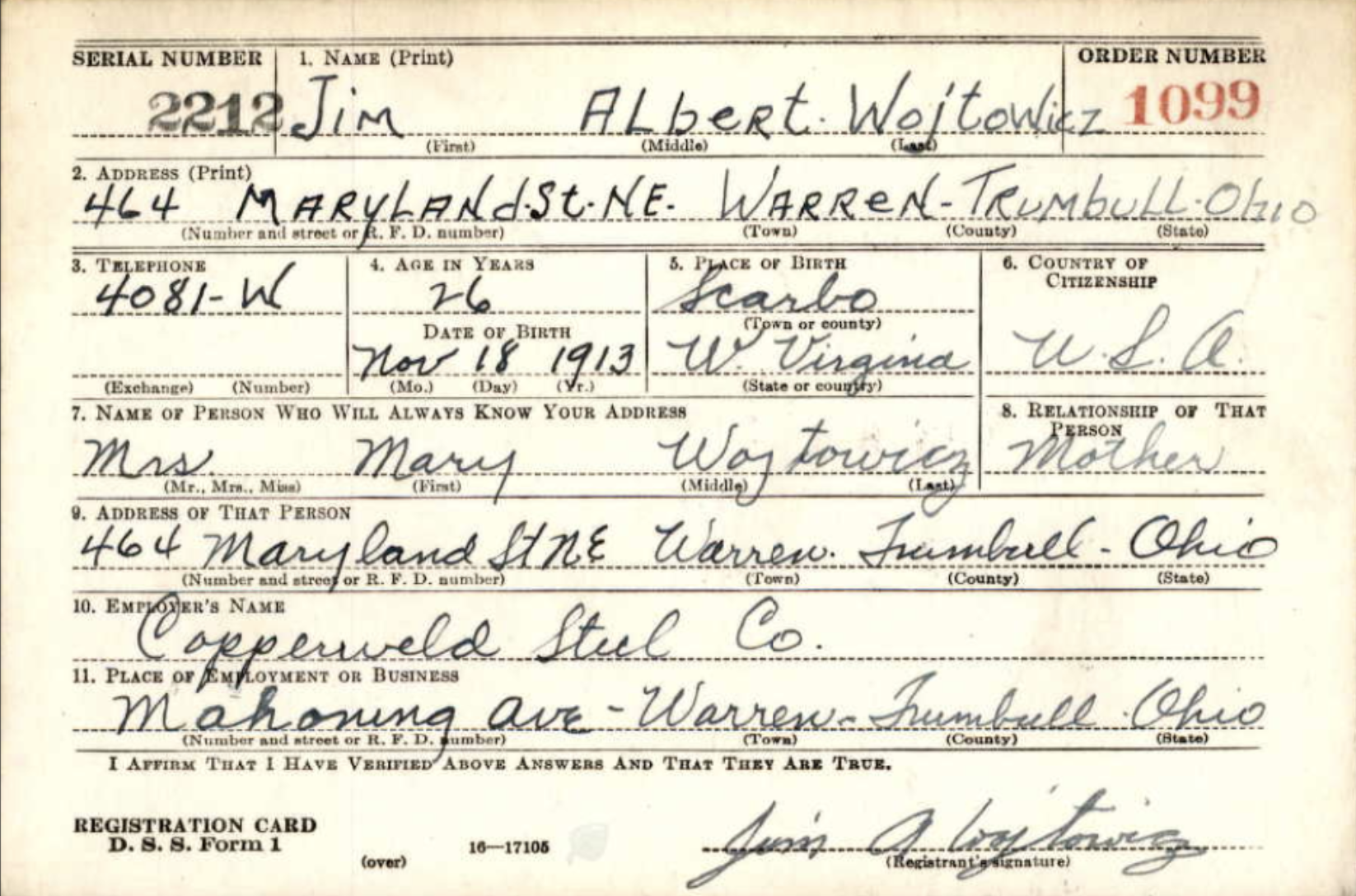
I have Jim’s draft card from 1942. He filled it out himself. Jim Albert Wojtowicz. 464 Maryland St NE. Telephone 4081-W, a party line shared with neighbors. Age 26. Place of birth: Scarbo, W. Virginia. Country of citizenship: U.S.A. Person who will always know your address: Mrs. Mary Wojtowicz, mother, same address. Employer: Copperweld Steel Co. Place of employment: Mahoning Ave, Warren, Trumbull, Ohio.
Jim joined the U.S. Army on October 21, 1943. He was 29 years old. He had a job. He had a family that needed his wages. He had no obligation to go. But Poland had been overrun by Nazi Germany since 1939, and Jim was a Polish-immigrant kid who had grown up speaking Polish at his parents’ kitchen table, and at some point in the fall of 1943 he decided he was going. He served in the U.S. Army Air Corps as a Technician Fifth Grade, which was the rank for soldiers with technical specialties. The Air Corps Tec 5s were the men who kept the airplanes flying: aircraft mechanics, radio operators, armorers, ground crew. Jim spent nineteen months in uniform. He was discharged on May 23, 1945, two weeks after V-E Day.
I know almost none of the details of his service. He never talked about it that I remember, and even if he had, I was a kid. The records that would tell me where he was stationed and which planes he worked on were probably destroyed in the 1973 fire at the National Personnel Records Center, which burned eighty percent of Army personnel records from his era. What I have is his headstone in Trumbull County, Ohio, which reads:
JAMES A. WOJTOWICZ TEC 5, US ARMY AIR CORPS WORLD WAR II NOV 18 1913 … MAR 31 1991
The boy born in a Polish-speaking coal patch in Fayette County who went down into the mines at fourteen came back from the war as an aircraft technician. The kid who learned to use a pneumatic chisel on iron castings learned to use precision tools on the most advanced flying machines in the world. For nineteen months he was closer to the future than anyone in his family had ever been. Then he came home and went back to Copperweld and worked the mill for thirty more years.
He retired from Copperweld in 1975 at age 62, taking the early reduced Social Security benefit because forty-eight years of mine, foundry, and mill work had been enough. He had another sixteen years to live in retirement, and that’s the entire window of my own memory of him. The Jim I remember from the corner of my grandmother’s kitchen at family parties was a retired man. The work in this post is work I never saw him do. By the time I was old enough to register him as a person, he had already put down the tools.
He never married. He never had kids.
In the year my grandmother, Louise, was born, my grandfather, Robert Hardman, was also born, in Ohio, in 1924. They didn’t know each other yet. Louise grew up in Warren as the second-youngest of ten Wojtowicz kids, watching her oldest brother, Jim, go off to the war while she was a teenager. Robert grew up in Ohio too. He served in World War II as a photographer for the Army. He came home, he and Louise met, and they married after the war. Robert spent the rest of his career as a professional photographer. A lot of his work was for the steel mills of Northeast Ohio. He photographed workers at their stations. He photographed plant interiors for company publications. He photographed the same industry his brother-in-law worked inside, from the other side of the camera lens.
Their son Gary, my father, became a photographer too. He worked alongside Robert, and eventually I worked alongside both of them as a kid in their studios.
That part of the story, three generations of photographers, isn’t strictly about Jim. But it’s the bridge. Jim’s wages and the wages of his brothers and sisters built the family that became the family that paid for cameras instead of pickaxes. The branch of the Wojtowicz line that ran through Louise married into the Hardman line and produced a family of artists. Each generation got further from the source material. Jim worked in coal and iron and steel and aluminum aircraft skin. Grandpa and my dad worked with light. I work with whatever this is.
As the older Wojtowicz siblings died, their things came up the family. Whoever had the biggest house and the most space took what was left over after the kids picked through. My grandparents had the biggest house. Louise, who we called Bacie, was one of the last to die, in 2010. Things from Jim, who died in 1991 and never had children of his own, came to her. When Bacie and Grandpa died, things came to my dad, and from my dad to me and my brother, Geoff. The Copperweld badge was in there somewhere. It survived the family the way the mill didn’t survive the country. It was in a Polish-immigrant kitchen, then a steelworker’s pocket, then an army duffel bag, then back into a steelworker’s pocket, then a sister’s drawer, and now it sits two feet from my keyboard.
I am four people away from a man born in a Polish coal patch.
Jim’s mother, Mary. Jim’s sister Louise, my grandmother. My Dad. Me. That’s the chain. Four people, four generations, one century, and a complete change in what work means.
I think about that a lot.
I work all day on a machine that thinks. The machine talks to other machines that also think. The machines, together, are building the next generation of machines that will think. Companies are worth trillions of dollars. Private companies are landing rockets back on the launch pad and sending them up again the next week. There is serious public conversation about colonizing Mars in my lifetime. Trillion is a word people use casually. I doubt Jim said the word billion in his entire life. I have an electric car that drives its self where I need to go. We live in a bonkers world.
The phrase “I am my ancestor’s wildest dream” gets said a lot online. I’m using it literally. Not as a slogan. As a fact about what I do for a living and how it relates to what Jim did for his.
Jim’s wildest dream, I think, was probably something like a steady paycheck and a roof over his mother’s head. He achieved that. Maybe he wanted a kid of his sister’s to graduate high school. They did. Maybe he wanted one of them to go to college. Some of them did. Maybe in his most expansive moments, lying in a barracks bunk somewhere in Europe in 1944 looking at the underside of a B-17 he was about to repair, he thought about what kind of country might come out of all this and what kind of life his nieces and nephews might have if it went the right way.
I don’t think his wildest dream included his sister’s grandson sitting in a home office in Alabama, building software with synthetic minds that talk to other synthetic minds. That was past the edge of what he could imagine. That was outside the field of his wildest dream. Not because he wasn’t smart enough to imagine it, but because there was no language for it, no precedent for it, no route from the world he lived in to the world I live in that any reasonable person would have predicted.
And yet here I am. Jim Wojtowicz’s great-nephew. Sitting at a desk with his work badge on it. Building a future that rests, in some real sense, on the work he did to keep his family alive long enough for it to get here.
I think about that when I’m in the middle of the work. When I’m frustrated with a build, or impatient with a launch, or grinding on a problem that won’t crack. I think about the man on the badge. The boy who went down into the mine with his father at fourteen. The young man who chipped castings in a Warren foundry. The Air Corps technician who came home with hearing damage and probably worse, and went back to the mill and the same room in his mother’s house. The uncle in the corner of the kitchen at family parties when I was a kid. The man who never had what the rest of us got to have. The man who paid for what the rest of us got to have.
He didn’t get to have what the rest of us got to have. The rest of us got to have it because he didn’t.
The badge sits on my desk to keep me honest about that.
Number 25-3806. A young man in a slicked-back haircut, holding a sign in front of his chest, on the day a Polish-American steel town gave him a number and a place to be every morning for what turned out to be most of his working life. He probably didn’t have a “wildest dream” at all. He just walked to the mine with his father, then to the mill on his own, then to the war, then back to the mill, and put in the shift.
I am Jim Wojtowicz’s wildest dream. And he didn’t even know I was coming.